Spain has more padel courts than anywhere on earth, and that density is the reason it is the best country in Europe to plan a padel week. Coaches, resurfacing specialists and ball suppliers are all local. Spanish clubs are among the strongest in the world, and any of these villas is a short drive from one.
It does mean the word "padel" on a villa listing can point at two different things: a good club nearby, or a court on the property. Both are worth having. Only one of them is free at seven in the morning.
A private padel court means the court is inside the villa gate, belongs to that villa, and cannot be booked by anyone else during your week. Everything below clears that bar. This piece covers the Ibiza villas, the one on Mallorca, what the courts are actually built from, and what the weeks cost.
Essentials
- Where
Seven villas on Ibiza, one on the west coast of Mallorca, in the Padel Hideaways collection.
- Sleeping
Ten to eighteen guests.
- Airports
Ibiza is fifteen to twenty-five minutes from every villa on the island. Palma is about forty minutes from Banyalbufar.
- Weather
Spain averages 30° in August and 27° in September.
- Rate
From about €27,710 a week in the shoulder season to €134,400 in peak, depending on the villa. Figures as at August 2026.
Which villas in Spain have a private padel court?
Ibiza, where most of them are
Ibiza has the deepest inventory of villas built around a court rather than fitted with one, and the properties differ more than the reputation of the island suggests.
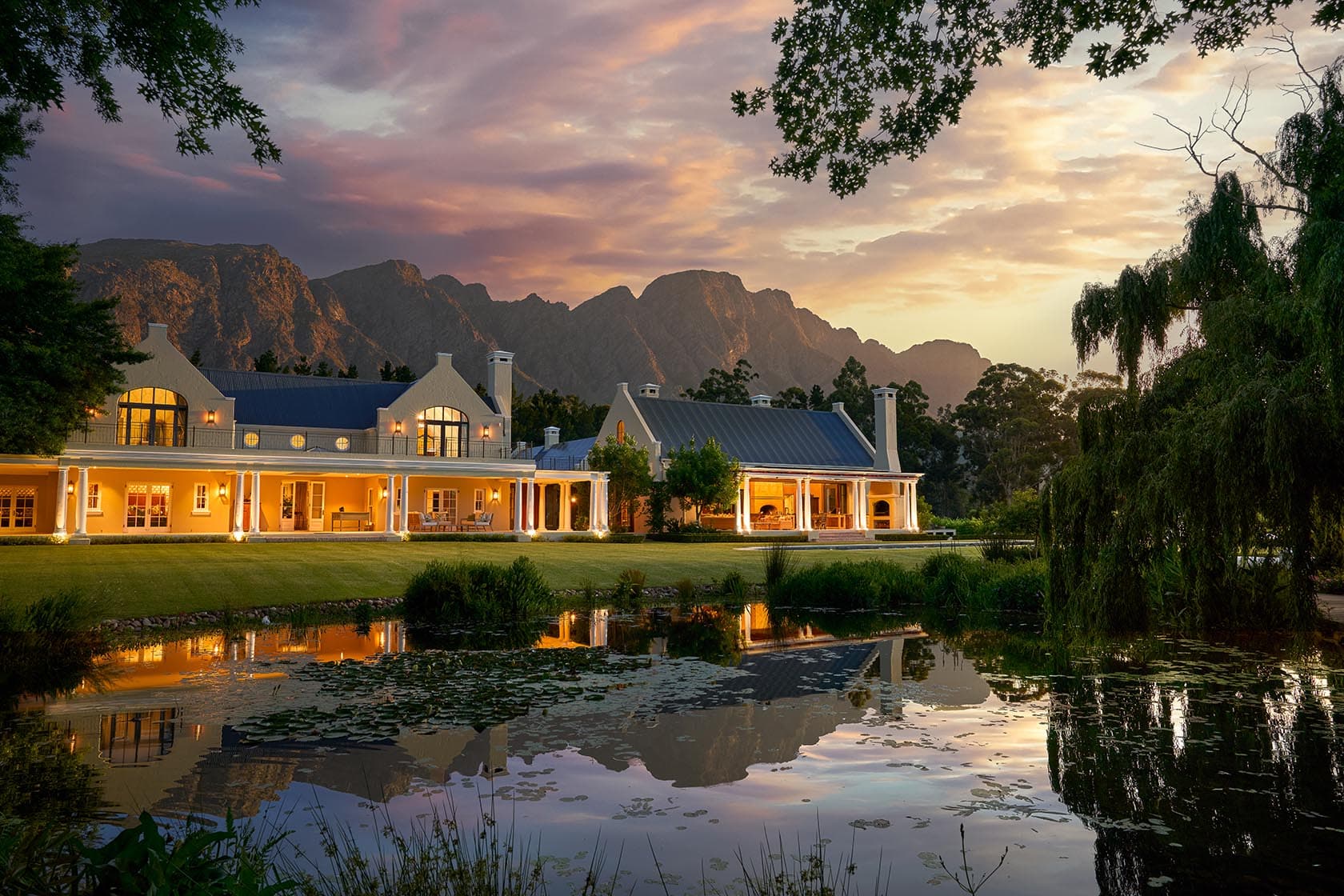
Villa Clarence is a 300-year-old Ibicencan farmstead with nine suites for eighteen, private land and a natural reserve around it, and no neighbours in view. The court sits inside the estate among the olive terraces, so the glass catches pool light rather than headlights. There is also a sauna, a cinema and a soundproofed cave to dance in, which is a specific set of priorities to find on one farmstead.
Villa Cantalou is a pueblo-style estate by Jaime Romano in Es Cubells, sixteen across the main villa and two guest houses, inside a natural reserve at the end of an unpaved stretch that keeps the passing world out. A Japanese garden runs from Mediterranean to tropical to wooded, the saltwater pool is 24 metres, and a chef is already inside the price. Es Cubells is the corner of the island Ibiza keeps for itself: a clifftop church, a handful of houses, no strip.
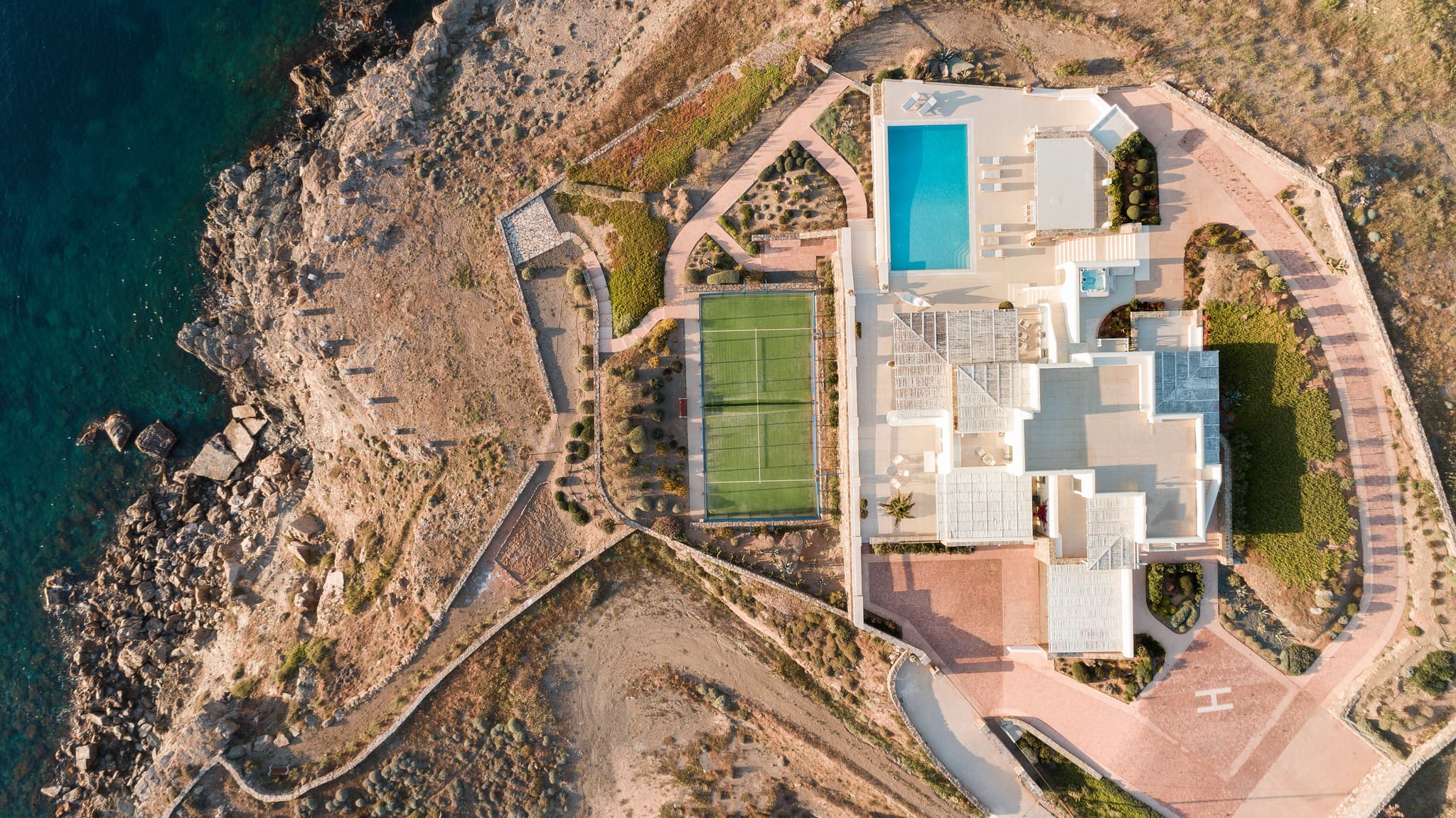
Villa Rubine on the Porroig peninsula has the most precisely specified court in the collection: green artificial turf, glass at both ends and mesh down the sides, four floodlight masts, benches courtside, and a basketball half-court on the same apron. It plays at nine in the morning and again after eight, with the middle of the day given to the pool and the steps cut into the rock straight into the sea. Five bedrooms, ten beds, ten sleep there.
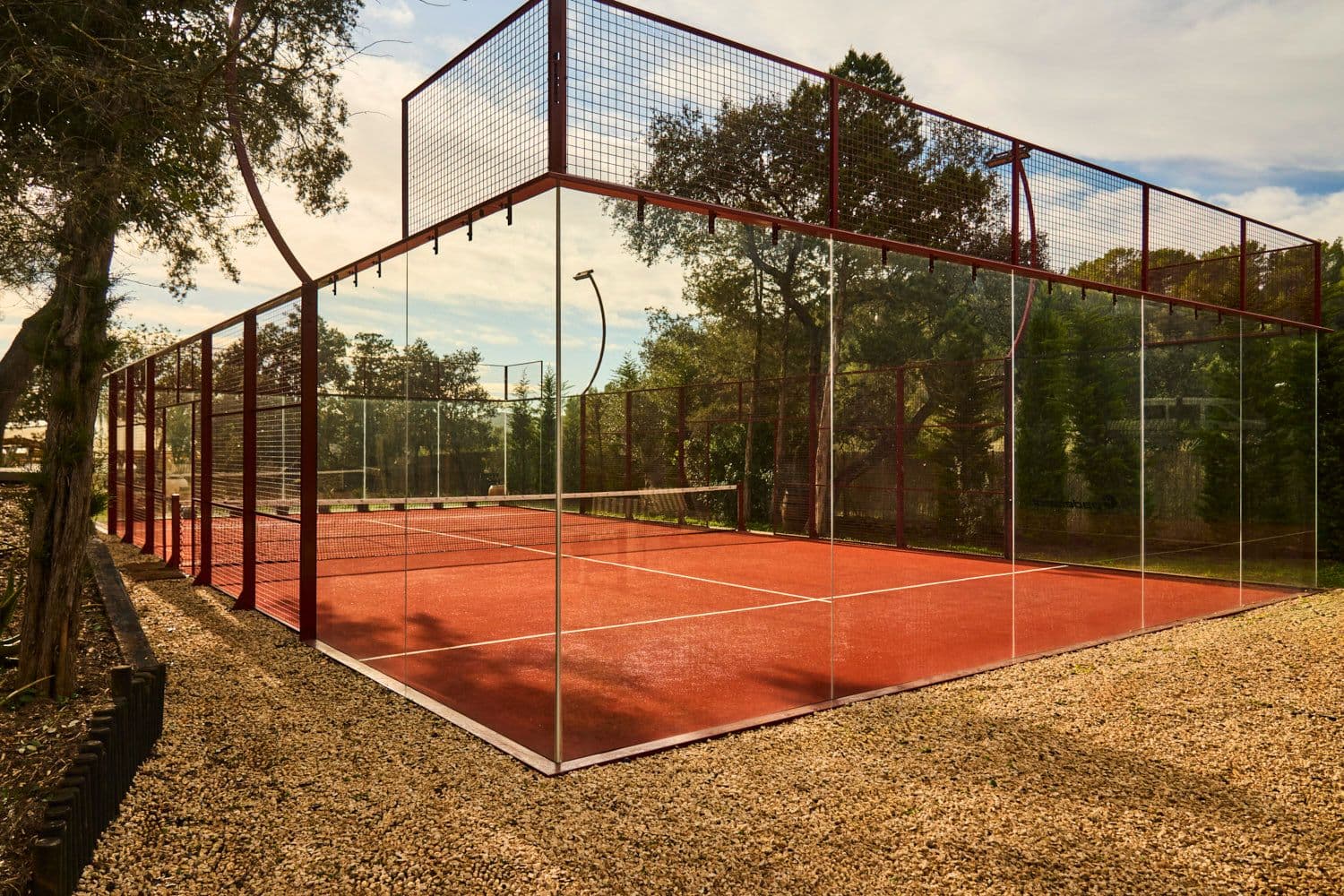
Bed configuration is worth asking about across all of them before you rule a villa in or out on numbers: Villa Cami has most of its doubles splitting to twins and Sa Punta de S'Àguila runs doubles and twins configurable, which changes what a mixed group of sixteen can actually do with the rooms.
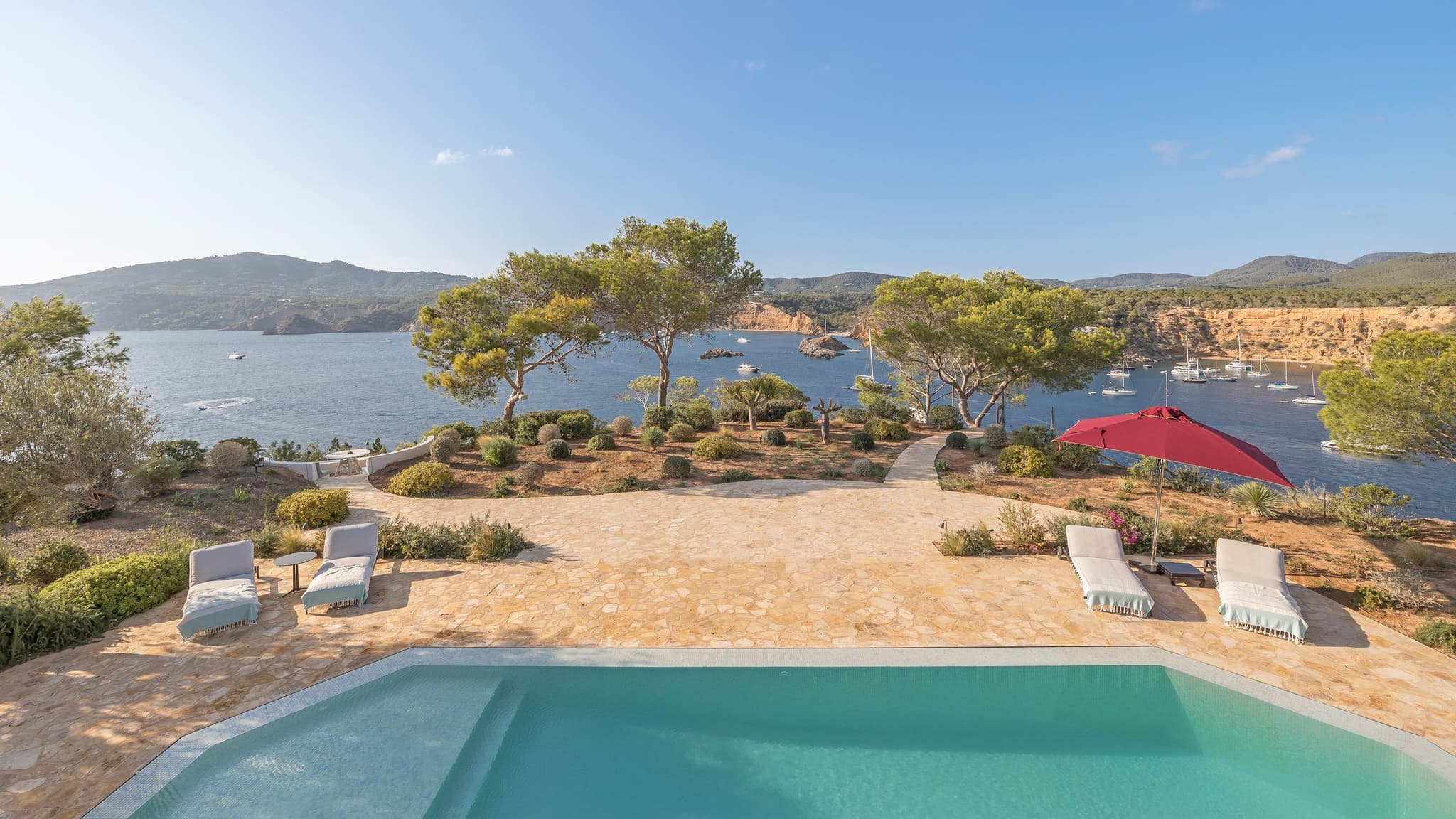
Casa Incendio puts sixteen in the Cap Martinet hills fifteen minutes from the airport, with an infinity pool over the Mediterranean and the court set into the terracing. Villa Cami takes sixteen at Sa Caleta with a sea view to Formentera and the court a few steps from the pool, among the fruit trees. Villa Solea sleeps twelve on the quiet south coast and is the rare Ibiza villa with no neighbours that is still five minutes on foot from dinner, with a volleyball court beside the padel court and an outdoor sauna for afterwards. Villa Fusion is ten, and carries the deepest wellness in the collection: sauna, hammam, hot tub and a massage room, with the court screened by the greenery and the beach five minutes down.
Mallorca, and the west coast
Sa Punta de S'Àguila is a honey-stone villa on a private estate above Banyalbufar, inside the UNESCO-protected Tramuntana, forty minutes from Palma. Five terraced suites for ten, a court screened by the terraces so it reads as part of the estate rather than bolted to it, and the mountains falling to the Mediterranean behind it.
Three of the eight, Villa Cantalou, Villa Rubine and Villa Solea, are provisional listings. They clear the gate, and where a surface, the glass or the floodlighting is still being confirmed with the owner, the villa page says so rather than guessing.
A note on Marbella and the Costa del Sol
The Costa del Sol has more padel infrastructure per square kilometre than anywhere in the world, and it is where a lot of the search volume for this question comes from. The clubs there are very good, which is precisely why a villa in the area rarely needs a court of its own. There is no Costa del Sol villa in the collection yet, and when one clears the gate it will appear on the collection page with the same seven categories as every other villa. Until then it seems more useful to say so than to fill the section.
What separates a real court from a listed one
The court is the gate. On site, private, and good enough to play on twice in a day. No court, no entry, whatever else the villa has. Past that gate, six questions do most of the work, and a villa worth its rate can answer all six.
- Dimensions
A padel court is 20 metres by 10 by federation rule. The LTA padel court guidance sets out the standard build. Undersized courts exist and they play wrong in a way you feel within a game.
- Surface
Artificial turf with sand infill. Concrete and poured resin are not the same sport, and a turf that is a decade old plays slow and slippery in a way no photograph shows.
- Glass or mesh
Glass at the ends is what makes the back wall part of the game. Mesh down the sides is normal and fine. Mesh at the ends is a different game, and the listing rarely volunteers which it has.
- Floodlights
Masts outside the perimeter, high enough to keep shadows off the playing surface. From October in Spain, floodlights are the difference between one session a day and two.
- Orientation
Which way the court faces decides whether six in the evening is playable or blinding. No listing carries it and every group notices it on day one, so ask.
- Private or shared
Inside the gate of a villa let to one group, nobody else can put a name against your Tuesday evening. Anywhere shared, the hours are booked in advance.
Ask for photographs of the court at the hour you intend to play, not the hour the photographer visited. A court shot at noon in June tells you almost nothing about a Tuesday evening in September.
When to go, and what that does to the rate
| Country | Jun | Jul | Aug | Sep | Oct |
|---|---|---|---|---|---|
| Spain | 26° | 29° | 30° | 27° | 23° |
Three degrees sounds like nothing and changes the shape of the day: in August most groups play early and late and give the middle to the pool. In late September more of the day is comfortable on court. The light still runs long, the sea is still warm, and you can walk into most restaurants on the island without a plan.
The rates follow the holiday calendar rather than the playing conditions, and the gap is wider than most people expect.
The widest of those is Villa Cantalou, which is €27,710 a week in the shoulder and €81,660 at the top of the summer for the same sixteen beds, the same garden and the same court. That is not an argument for the cheaper week. It is an argument for the better one, and the two happen to coincide.
What a week costs
As at August 2026, shoulder and peak, per week, for the whole villa.
- Villa Cantalou
Sleeps sixteen, Es Cubells: €27,710 and €81,660, chef included.
- Casa Incendio
Sleeps sixteen, Cap Martinet: €35,000 and €44,800.
- Villa Rubine
Sleeps ten, Porroig: €39,500 and €64,750.
- Villa Cami
Sleeps sixteen, Sa Caleta: €40,376 and €65,905.
- Sa Punta de S'Àguila
Sleeps ten, Banyalbufar: €44,800 and €56,700.
- Villa Solea
Sleeps twelve, Vista Alegre: €48,485 and €73,745.
- Villa Fusion
Sleeps ten, Sant Josep: €81,662 and €134,400.
- Villa Clarence
Sleeps eighteen, Ibiza: €89,999 and €115,073, chef and concierge included.
Villa Clarence at eighteen and Villa Fusion at ten sit in the same broad band per week and a long way apart once the week is split between the people in it. Each villa page works that out for the group size you enter.
What gets added to the week
Every villa in the collection is presented the same way: the villa itself, then four things that can be added to it. Concierge, driver, chef and coach, taken all four or none, quoted as one price with the week rather than priced item by item on the page.
For a padel week the coach is the one worth thinking about first. Structured mornings turn a holiday where people played into a week where people improved, and they handle a wide spread of ability better than seeding the doubles carefully does. Villa Clarence and Villa Cantalou already carry a chef. The rest quote one.
Frequently asked questions
What are the top luxury villas in Spain with private padel courts?
On Ibiza: Villa Clarence, Villa Cantalou, Villa Rubine, Casa Incendio, Villa Cami, Villa Solea and Villa Fusion. On Mallorca: Sa Punta de S'Àguila above Banyalbufar. All eight have a court inside the gate that no one else can book during the stay.
How much does a villa with a private padel court in Spain cost?
Across the collection, from about €27,710 for a shoulder week to €134,400 for a peak week, whole villa, sleeping ten to eighteen. The spread within a single villa is larger than most people expect, and the widest peak premium in the collection is for the identical villa and court.
What court specifications should I check before booking?
Four things in writing: dimensions of 20 by 10 metres, an artificial turf surface with sand infill, glass at the back walls rather than mesh or concrete, and floodlight masts outside the perimeter and high enough to keep shadows off the surface. Two more are worth asking on a call, because no listing carries them: which way the court faces, and whether anyone outside your group can book it.
Is Ibiza or Mallorca better for a padel villa week?
Ibiza has far more villas with a court of their own, and more variety among them, from a 300-year-old farmstead to a frontline villa with steps into the sea. The case for Mallorca is the west coast itself: Sa Punta de S'Àguila sits inside the protected Tramuntana, forty minutes from Palma, which is a different kind of week entirely.
When is the best month to play padel in Spain?
Late September. Spain averages 30° in August and 27° in September, and that difference is the difference between a court you cannot use in the middle of the day and one you can play on twice. October holds up well too, provided the court is floodlit.
Do these villas come with a padel coach?
A coach is one of four things quoted with the week alongside a concierge, a driver and a chef, taken together rather than separately. For a group with mixed experience it is the addition that changes the week most, because padel is unusual in letting a beginner and a club player share a court and both enjoy it.
How far in advance should I book?
Peak summer weeks go early, and the villas that sleep sixteen or more go earliest. Late September and October hold their availability longer, and they are the better weeks to play.
Share this piece