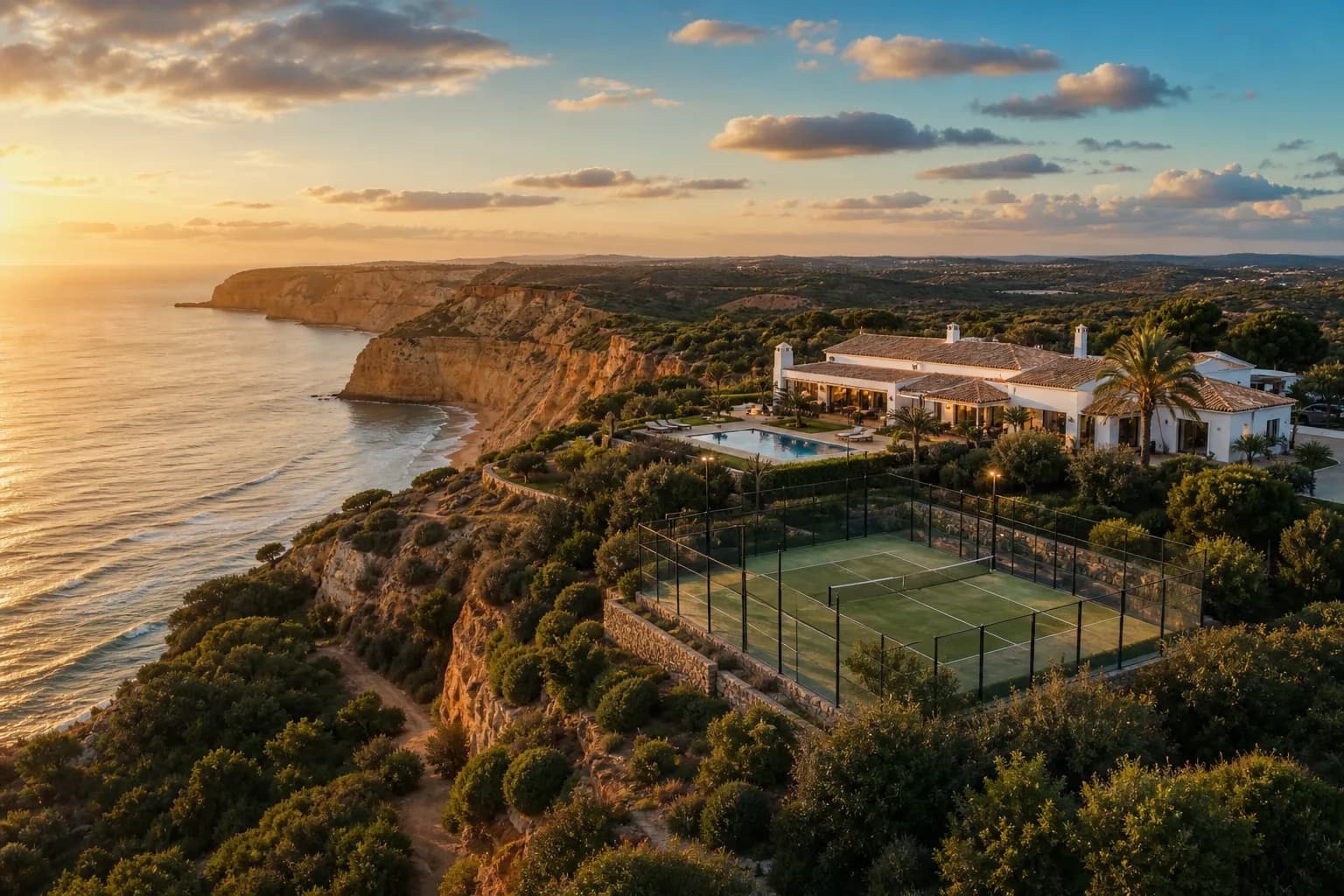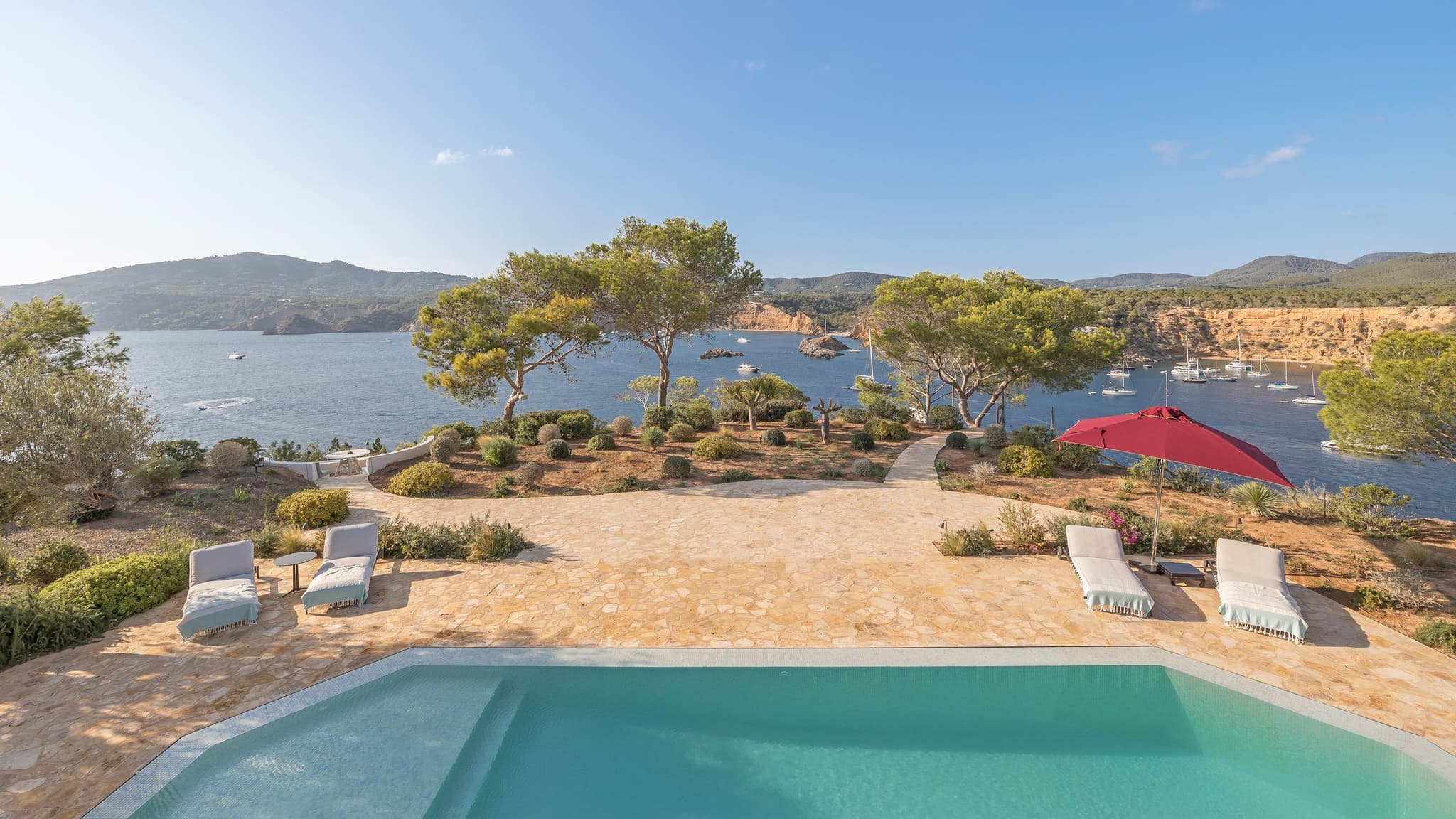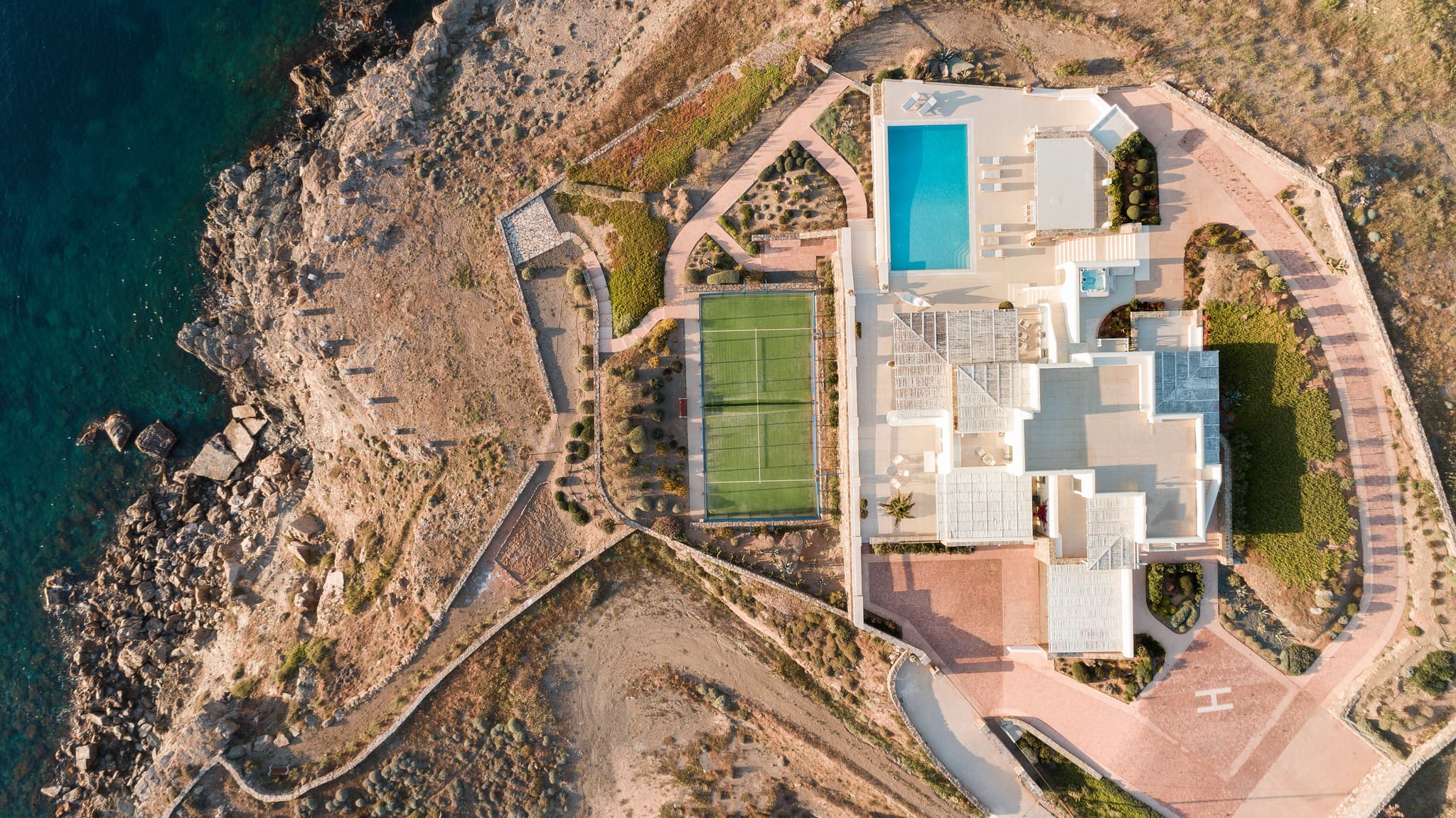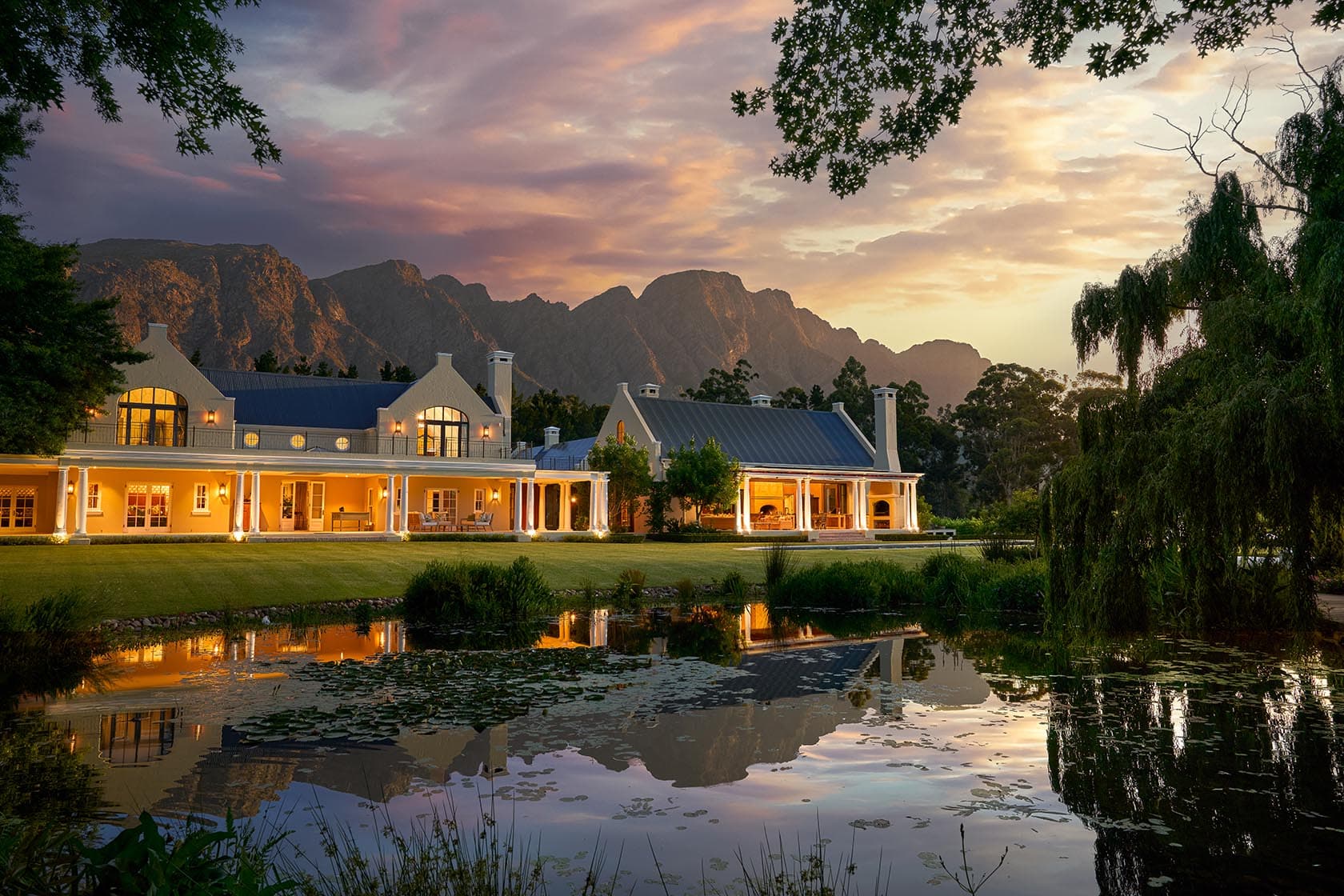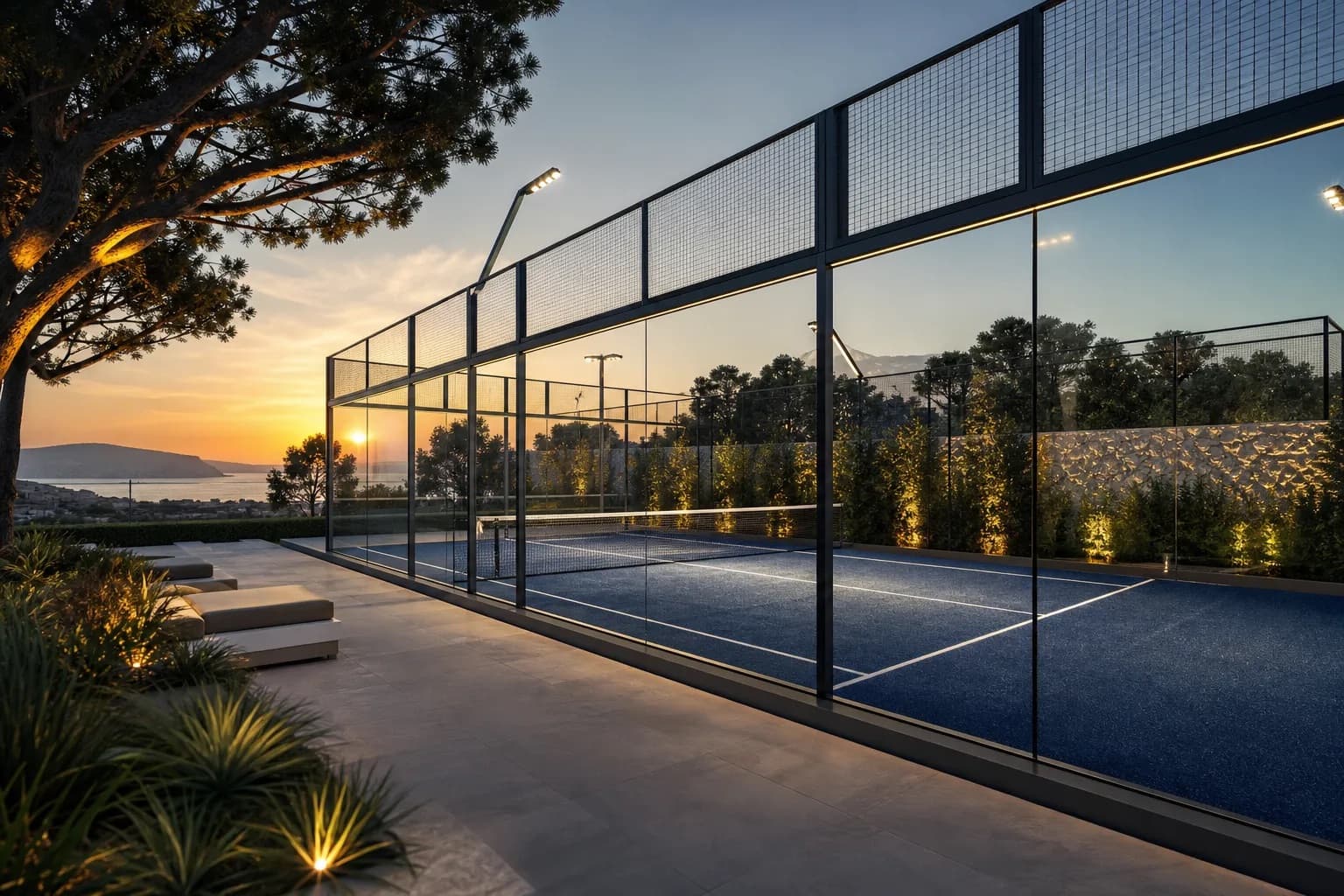
You know within about four points. The ball comes off the back glass and dies instead of coming through. The panel flexes when someone leans on it. At six in the evening one end of the court is lit and the other is a guess. A court can look right in every photograph and still be wrong to play on, and the gap between the two is made entirely of things a photograph cannot show you.
Whether you are briefing a builder for your own garden or reading a villa listing before you commit a group to a week, the same five systems decide it: the glass, the surface, the light, the base underneath, and what the noise does at the boundary. They are not independent. Premium glass in a cheap frame is a cheap court, and the best turf in the world laid on a base that moves will be a bad court by its third winter.
Essentials
- Court size
Twenty metres by ten, by federation rule, with back walls four metres high: three metres of glass and a metre of mesh above it.
- Glass
12 mm tempered safety glass to EN 12150-1 is the sensible baseline. 10 mm meets the minimum and is the lower end of acceptable.
- Surface
UV-stabilised monofilament turf, 10 to 13 mm pile, silica sand infill, over a sports-grade shockpad.
- Light
200 to 300 lux maintained average for evening play at home, 4000 to 5000K, four to eight fixtures at six to seven metres.
- Base
Reinforced perimeter foundation below the frost line, free-draining sub-base, and a half to one per cent fall across the surface.
- Noise
A dense, gapless acoustic perimeter, specified on what it does at your boundary rather than what it did in a laboratory.
The glass, and what it tells you first
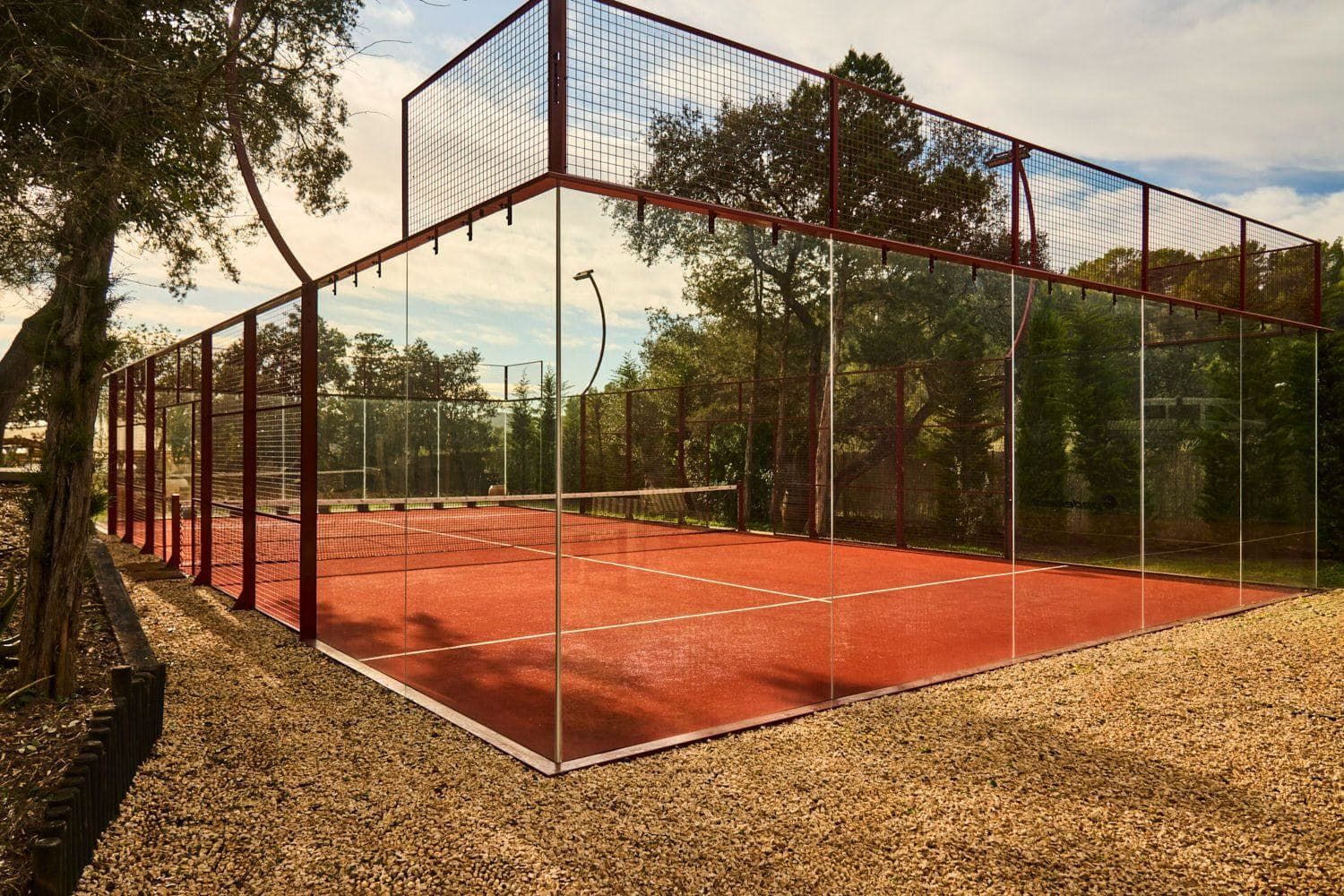
The glass is the most visible part of a court and the fastest read on how seriously it was built. A regulation court is twenty metres by ten, with the back walls at four metres total: three metres of tempered glass with a metre of steel mesh above it, and the side walls stepping down from three metres at the back towards the net. Those dimensions are fixed by FIP rule and do not relax for a private garden. What varies enormously is what the panels are made of and what holds them.
Twelve millimetre tempered safety glass to EN 12150-1 is the specification worth insisting on. Ten millimetre panels satisfy the minimum and are common on domestic installations, and the difference is not academic: the thicker panel is stiffer, quieter under impact, and returns the ball more predictably. Where post-breakage behaviour is the priority, laminated tempered glass with a PVB interlayer holds a broken panel in place instead of letting it go, and manufacturers rate it for a longer outdoor life than plain tempered. Ask any supplier quoting lifespans to put the figure in writing against a warranty rather than a brochure.
The frame decides more than most builders volunteer. Hot-dip galvanised steel is the standard for anything outdoors, and it is what keeps the geometry true through ten winters. A premium panel bolted into a thin frame will rattle, and the rattle is not cosmetic: it changes the rebound. Full panoramic configurations, where glass replaces the mesh sections, improve ball visibility and let a court sit in a garden rather than dominate it.
The surface: turf, infill and the pad underneath
Surface is where court quality stops being visible and starts being felt. Almost all residential courts use artificial turf, and the variables that matter are fibre type, pile height and infill.
UV-stabilised polyethylene monofilament is the right fibre, not fibrillated. Monofilament holds its shape under hard use and gives a consistent response across the whole court rather than a fast patch and a slow one. Pile height between 10 and 13 mm is the range that plays properly: shorter feels hard and unforgiving, longer starts to swallow the ball. Silica sand infill keeps the fibres upright and sets how much the foot slides, and it should be silica sand rather than a sand and rubber blend. The professionally certified systems, including FIP and FEP approved turf from Mondo, Realturf and CCGrass, are built around exactly these numbers.
Underneath it, a shockpad is the upgrade that separates a serious build from a standard one, and the specification word is sports-grade. A sports shockpad takes load out of the knees while leaving the bounce alone. A soft recreational pad deadens the ball and ruins the court. They cost within a little of each other and play nothing alike.
Turf ages, and it ages invisibly. Ten-year-old turf photographs beautifully, plays slow, and slides in a way that puts people on the floor. When a villa quotes a surface, ask what year it was laid.
Floodlights, and the three hours a day you lose without them
From October in Europe you lose roughly three hours of play a day without lights, which turns a court into a morning amenity, and it is the reason a floodlit court is worth paying a shoulder-season premium for while an unlit one is not. This is also the system most often specified by whoever was cheapest.
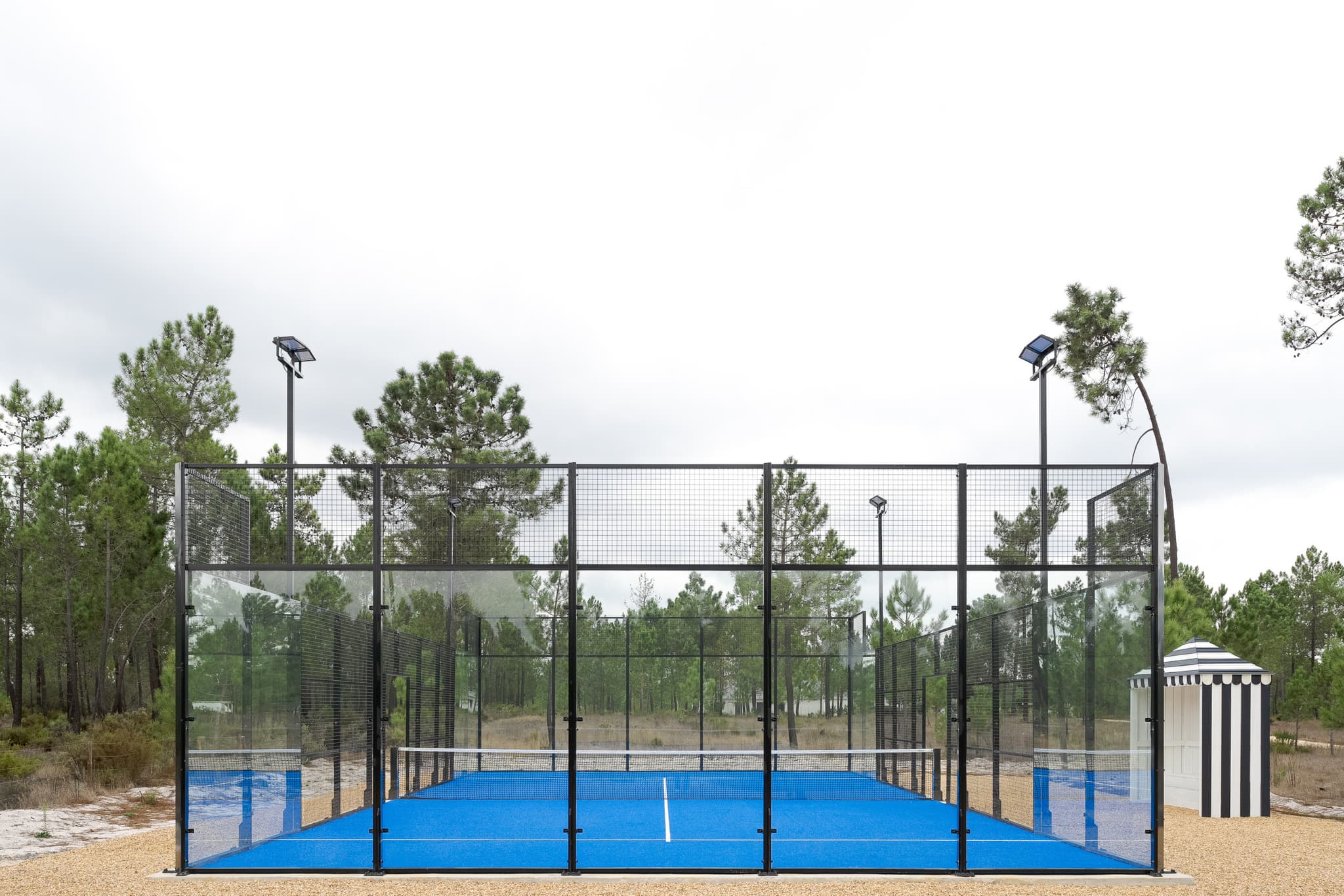
For evening play at home, a maintained average of 200 to 300 lux is the right target, and 300 to 500 lux gives a club feel. Competition and broadcast levels start above 500 and are irrelevant in a garden. In practice that is four to eight LED floodlights of 150 to 200 W, mounted at six to seven metres and angled inward so the light lands on the court instead of in the eyes, drawing something like 1.2 to 1.6 kW on a dedicated weatherproofed outdoor circuit.
Colour temperature is a playing decision before it is an aesthetic one. Neutral to cool white in the 4000 to 5000K range tracks a fast ball accurately. Warm light below 3500K flatters a garden at ten at night and makes the ball harder to read, which is the wrong trade on a court that gets used.
And then the thing no listing carries and every group notices on day one: which way the court faces. An east to west orientation puts the setting sun straight down the court, and six in the evening in September becomes unplayable at one end. North to south is the answer. If you are booking rather than building, this is the single best question to ask, because nobody has ever put it in a listing.
The base, the fall and the drainage
The foundation is the least interesting part of a court and the one that decides whether it still plays in year eight. Courts on inadequate bases crack, tilt and hold water, and no turf specification rescues a substructure that is moving.
Outdoor courts are normally built on a reinforced concrete ring beam or strip footing carrying the perimeter posts, founded below the local frost line, which means something between 80 cm and 1.5 m depending on where you are. Above it sits roughly 250 mm of free-draining, non-frost-susceptible aggregate in a temperate climate, with perforated drainpipes, a geotextile membrane and lined trenches so the sub-base does not silt up.
Surface water is handled by a fall of half to one per cent built across the court. It is invisible to anyone playing and it is the difference between a court that is dry an hour after a storm and one that grows algae in its low corner. In cold climates the specification extends to frost-protected foundations with air-entrained concrete. In wet temperate ones, a porous asphalt or concrete slab over a draining granular base does the same job a different way. Applying one climate's detail to another climate's site produces failures that are expensive and slow to appear.
Noise, and the neighbours
Padel is loud in a specific way. The racket strike and the ball hitting glass are short, sharp and high frequency, which carries further than the volume suggests and is exactly the sound a planning objection is made of.
An effective perimeter uses dense material installed without gaps: acoustic timber panels or absorptive composite systems. Well specified, that takes something in the order of 10 to 15 dB off the perceived noise at the property boundary. Laboratory ratings for the same products run far higher, and the gap between the two is where the arguments happen. Ask the contractor for the installed reduction at your boundary, not the laboratory rating of the panel.
The same perimeter does two other jobs at once. It screens the court from the neighbours in both directions, and on an exposed or coastal site it breaks the wind, which affects ball flight more than most people expect until they have played in it.
What to ask, whether you are building or booking
For a contractor, the brief is short and specific: 12 mm tempered glass to EN 12150-1 in a hot-dip galvanised frame, monofilament turf at 10 to 13 mm pile with silica sand infill over a sports-grade shockpad, four to eight LED fixtures delivering a maintained 200 to 300 lux at 4000 to 5000K, an acoustic perimeter quoted on boundary performance, and a reinforced foundation below the frost line with a half to one per cent fall. Planning requirements vary widely between Portugal, Spain, the UK and the US, and the conversation with the local authority belongs before the groundworks are designed rather than after.
For anyone booking a villa, the same knowledge becomes six questions, and none of them require a technical answer to be useful.
- Is the court on the property and private to it?
A court ten minutes away is a club membership with a drive attached.
- Is it full size?
Twenty by ten. Undersized courts play wrong inside a game.
- What year was the turf laid?
Not what it is. When it went down.
- Glass or mesh at the ends?
Glass makes the back wall part of the point.
- Is it floodlit, and to roughly what level?
Floodlit and playable at nine at night are two different claims.
- Which way does it face?
North to south. Nobody has ever put this in a listing.
That is the gate for everything in this collection: on the property, private to it, and good enough to play on twice in a day. Where a surface or a floodlight specification has not been confirmed with the owner, the villa's page says so rather than guessing. An unconfirmed line is more useful than a confident one, because the court is the reason anyone got on the plane.
The court is one of six things that decide a group week, and it is not always the one that decides it: the six questions that turn a long list into a short one covers the other five. For how the courts actually vary by country, Portugal and Spain are written up villa by villa.
Frequently asked questions
What are the key features of a high-end padel court for a private residence?
Five systems, and they depend on each other. A 12 mm tempered glass enclosure to EN 12150-1 in a hot-dip galvanised frame. Monofilament turf at 10 to 13 mm pile with silica sand infill over a sports-grade shockpad. LED lighting at a maintained 200 to 300 lux in the 4000 to 5000K range. A dense, gapless acoustic perimeter specified on boundary performance. And a reinforced foundation below the frost line with a half to one per cent fall for drainage. Get one wrong and the others cannot compensate.
What glass specification should a private padel court use?
12 mm tempered safety glass to EN 12150-1 as the baseline. 10 mm is the common minimum and is noticeably less stiff. Laminated tempered glass with a PVB interlayer is the upgrade where post-breakage safety matters, because a broken panel stays in its frame. The frame matters as much as the panel: hot-dip galvanised steel, or the glass will not hold its geometry.
What lux level does a private padel court need?
A maintained average of 200 to 300 lux for evening play at home, 300 to 500 for a club feel. Above 500 is competition and broadcast territory and is not worth paying for in a garden. Mount the fixtures at six to seven metres, angle them inward, and choose 4000 to 5000K so the ball reads clearly.
Which way should a padel court face?
North to south wherever the site allows it. An east to west court puts the low sun straight down the length of the court, which makes the last playable hours of the day unplayable at one end. It is the specification most often ignored on private builds and the one players notice first.
Does a padel court need a shockpad?
Not to function, but it is the clearest upgrade available. A sports-grade shockpad reduces load through the joints across a long week without changing the ball response. The mistake is fitting a soft recreational pad instead, which deadens the bounce and takes the life out of the court.
How can I tell if a rental villa's padel court is any good?
Not from the photograph, which is the whole problem: turf age, glass thickness, lux level, drainage fall and orientation are all invisible in a picture. Ask the six questions above before you book. A property that answers them specifically has a court someone thought about. A property that answers them with adjectives has a rectangle.
Share this piece